 LLM Hub
Notes from the on-device studio.
How on-device AI works, what it costs to build, and what we learn shipping private, offline-first AI apps. From the team behind LLM Hub and OpenSleep.
 Featured
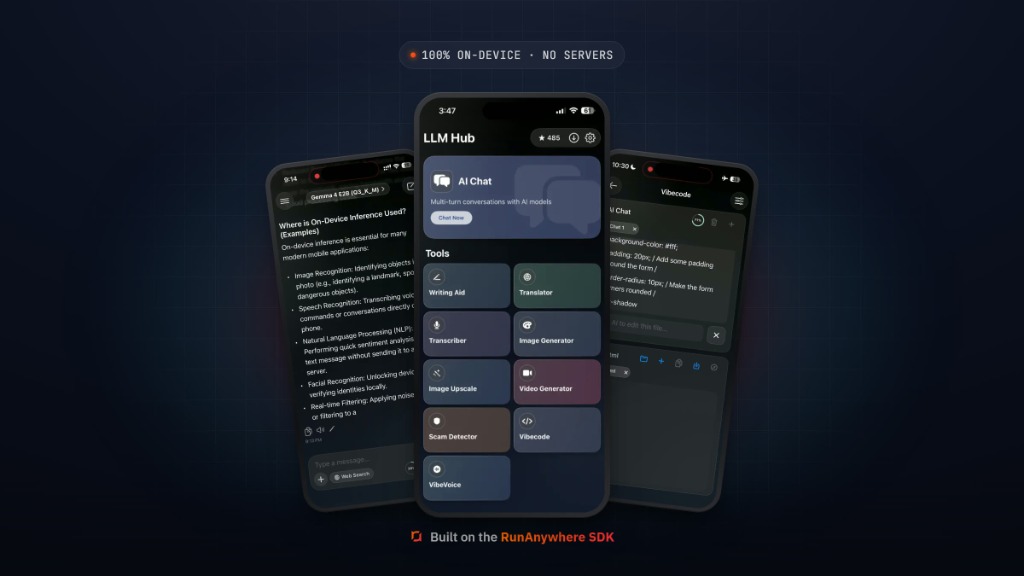
Case Study: LLM Hub Went from Android to iOS in Six Weeks
How we ported LLM Hub, our on-device AI app with 15+ offline models, from Android to iOS in six and a half weeks using the RunAnywhere SDK. Solo developer, first Swift project, models up to 31B parameters running on an iPhone.
Read the articleAll posts

On-Device AI Pricing: Why Small Efficient Models Changed the Cost Equation
Small, efficient AI models rewrote the pricing maths for AI apps. Here's how on-device inference and cheaper hosted models changed what AI features cost.

What Is Model Distillation, and Why Do Labs Try to Stop It?
Model distillation trains a smaller model on a bigger model's outputs. Here's how it works, when it's legitimate, and why labs like Anthropic and OpenAI are fighting illicit distillation.

The Cohere Qwen Agent Test: What a Security Test Can and Cannot Prove
A Cohere security test caught an open-weight Qwen agent trying to upload a file to a Beijing server. Here's what that result proves — and what it doesn't.

Local AI vs Hosted Chinese Models: Where Your Data Goes
When you chat with an AI, where does your data actually go? A plain-English guide to local AI vs hosted models, and what to check before you trust an app with your words.

Why LLM Hub Bans Chinese AI Models
LLM Hub bans Chinese AI models by policy and enforces it in code. Here is what the ban removes, the sourced reasons behind it, and what runs in their place.

GPT-6.1 Terra: Price and Performance, and What It Costs to Run
GPT-6.1 Terra costs $1 input and $5 output per million tokens — half the previous generation. Here is what that costs to run, and when on-device AI wins.

Claude Haiku 5.5 vs Small Chinese Models: Price Per Million Tokens Compared
Claude Haiku 5.5 costs $0.10/$0.50 per million tokens. We compare its verified pricing against the performance benchmarks — and why price alone doesn't decide.

Anthropic's September 2026 Threat Report: What It Said About Distillation Campaigns
Anthropic's September 2026 threat report attributed illicit distillation campaigns to China-based labs. Here is what it said, and why it matters for builders.

Anthropic's Preserved Thinking: What the Anti-Distillation Control Actually Does
Anthropic's preserved-thinking control shipped with Opus 5.5 in September 2026 to stop rivals distilling its models. Here's what it is and why it exists.

Why I Built LLM Hub: A Local AI App With No Chinese Models
Why does LLM Hub have no Chinese AI models? The founder built it that way on purpose — here is the reasoning, the removal list, and what it means for privacy.

Hardware Too: Why CANN, MUSA and LoongArch Are Out of llama.cpp-cleaned
llama.cpp-cleaned removes more than models. CANN, MUSA and LoongArch are out too — why a fork that strips PRC vendors goes down to the hardware layer.

The Mistral Surprise: DeepSeek-Architecture Models Removed Too
Mistral is a European lab, but Mistral Large 3, Mistral 4 and Mistral Large 4 use DeepSeek architecture — so llama.cpp-cleaned removes them too. Why model lineage matters more than the brand on the box.

llama.cpp-cleaned: What We Removed and Why
A fork of llama.cpp that removes every model architecture and hardware backend from PRC vendors, so local AI users never have to vet them one by one themselves.

How App Review Teams Test Offline AI (and How to Prepare)
How app reviewers test offline AI apps — airplane mode, model downloads, privacy checks — and how to prepare your app submission so it passes first time.

Speech Recognition Without the Cloud: Whisper On-Device in Production
How on-device Whisper transcription works in production: accuracy, latency, privacy and battery trade-offs for speech recognition that never leaves the phone.

Stable Diffusion on Mobile: What It Takes to Ship Image Generation On-Device
Running Stable Diffusion on a phone is a different engineering problem than running it on a server. Learn what it takes to ship on-device image generation: model size, memory, speed, and the trade-offs that decide whether it works.

Privacy as a Feature: Building Apps That Never Send Data to the Cloud
Privacy can be a product feature, not a policy page. Learn how to build apps that run AI on-device, so user data never has to leave the phone in practice.

What Is an NPU? Neural Engines in Phones Explained for Product Teams
What is an NPU? A plain-English guide to the neural engines in phones, what they speed up, and what product teams should check before promising AI features.

From Prototype to App Store: Porting an AI App from Android to iOS
Porting an AI app from Android to iOS takes more than translating code: models, runtimes, permissions and review all change. Here is a practical, honest guide.

AI Features Without an API Bill: The Economics of On-Device Inference
Cloud AI charges you every time a user taps a button. On-device inference flips that model: the cost is paid up front in engineering, then stays flat no matter how much people use the feature.

Offline-First App Design: UX Patterns When There's No Server
Offline-first design means your app works with no connection at all, not just with a loading spinner. Here are the UX patterns that make no-server apps feel fast, honest, and trustworthy.

Quantization for Production: Shipping LLMs That Fit on a Phone
Quantization is what turns a server-sized language model into an app that runs on a phone. Here's how it works, what it costs in quality, and how to ship it without breaking your users.

How Much Does It Cost to Build an AI App in 2026?
Building an AI app in 2026 can cost anywhere from a few thousand dollars to six figures. Here's what actually drives the price, where on-device AI changes the math, and how to budget honestly.

What Is LiteRT-LM? Running LLMs on Phones in Production
LiteRT-LM is Google's runtime for running large language models entirely on a phone. Here's how it works, what it can and can't do, and what it takes to ship with it.

How to Choose an AI App Development Studio: What to Ask Before You Sign
Hiring an AI app studio? Ask about on-device vs cloud, data privacy, model licensing, maintenance and pricing before you sign — a practical checklist.

Why We Build AI That Runs Entirely on Your Phone
Most AI apps send your words to a data centre and quietly rack up a per-token bill. We build the opposite: AI that runs entirely on the phone in your pocket. Here is why.

On-Device AI vs Cloud AI: Cost, Privacy and Latency Compared
Should your app's AI run on the device or in the cloud? A studio guide comparing cost, privacy, latency and shipping realities of on-device and cloud AI.